Thursday, April 12, 2012

Ancient Roman Costumes Would Brief You About The Kind Of Garments

Ancient Roman costumes worn by everyday folks in the Roman Empire were mainly loose articles of clothing that draped around the body and were secured by fasteners. For both men and women, undergarments were called tunics. Women wore clothing called the stola over their tunic, a long garment reaching to the ankles consisting of two pieces of fabric, one on the front and the other in the back, held together by pins at the shoulder, which were called fibulae. The Statue of Liberty is actually "wearing" a stola.

It also had two belts, one fitting just below the breasts, the other around the waist. This created a great many luxurious folds, a fashionable trick at that time - the more folds, the richer and more upper class she looked. If a woman went outside, she usually wore an overcoat called a palla, which was basically a long shawl. It usually draped over one shoulder and across the entire body. Extra folds could be used to pull over the head.

The ancient Roman civilization and architecture is one of the most popular in the world. The world has learnt a lot of things from the Romans. There are several interesting facts about the Romans. Right from their lifestyle to food and clothing, everything was advanced and remains a wonder for the rest of the world. Also, some historians believe that ancient Roman clothing was very different and unique from the clothing found during that period.

Romans were known to use different varieties of fibers to create their clothing. Their fabric made to stitch their tunic was made out of wool, hemp and linen. The ancient Romans wore well stitched clothes and they had different types for men and women.

The toga was a popular kind of dress and was standard for Romans. The Romans also wore clothes according to their status in the society. The toga was a long garment which was like a sash and was made out of wool. It was like a tunic for the Romans. The toga was also worn by magistrates and was mostly plain white in color. Even scholars and teachers wore them. Some togas had a purple stripe on them.

The stola was very similar to the toga and was like a blanket that needed to be wrapped around the body. This was usually wrapped around another piece of clothing called tunica. Usually girls and women wore tunic with a stola wrapped around it.

Cloaks were another form of popular clothing and generally were very colorful. They were made out of wool and linen, and were worn when going out.Though the tunic was considered an undergarment, it was often the only thing worn, or two tunics - an inner one and a shorter outer one. Most common Romans and slaves simply slipped on their tunic and went about their days business.

While women wore a stola over their tunics, men wore the toga. Actually, only male Roman citizens could wear a toga in public - it was the stately, official and cumbersome dress, representative of the Roman Republic and into the Empire (it was actually originally used by the Etruscans, the civilization that flourished before Rome - the town of Rome overthrew the Etruscan royalty and began their own conquest of Italy.)

The toga was a large (around 20 feet) length of cloth that was wrapped around the body. Because it was difficult to wear, it was usually only worn on official occasions, much like tuxedos and evening gowns are worn today. In fact, slaves and servants from rich families specialized in toga dressing, making it as fashionable and comfortable for their master as possible!

The way Romans wore their clothing indicated their status symbol. Higher class women would wear more layers of clothing, indicating their wealth. The more folds and layers, the better. The colors of Roman costumes also mattered. Magistrates wore clothing that had a purple border. Generals wore togas with golden hems to signify success in battle. Emperors wore purple robes, as this color was rare and expensive.

Finally, basic sandals that lace up the leg were the standard type of footwear. Both men and women wore these type of sandals, without socks, which were only invented when the Romans conquered more northern territories like Germany and Britain. Unlike the warm Mediterranean climate, sandals by themselves would quickly freeze the skin!

To dress as a Roman for your Halloween costume, a white or red toga is your best choice, as it is the most distinctive. A stola isn't very well known, and few would know the difference anyway! If you wish to look like a high class Roman man, wear a luxurious toga lined with gold trim. As an aristocratic woman or an empress, wear a red costume with a shawl.

Sunday, April 1, 2012

Dragon Robe Is A Prime Of Chinese Ancient And Rich Cultural Costume

The robe embroidered with dragon patterns was made for the exclusive use of an emperor during the Qing dynasty. The ritual of embroidering dragon patterns on the emperor's robe, however, dates back to as early as the Zhou Dynasty (11th century-256 B.C.).

During the Yuan and Ming, the emperors were already wearing robes graced with dragon patterns, but it was not until the Qing that they were named “dragon robes” and became part of the official attire system. A dragon robe is either yellow or apricot-yellow dragons in color, and embroidered with nine yellow dragons and five-hued auspicious cloud patterns.

The clouds are interlaced with twelve other patterns—the sun, the moon and stars (representing the light of the throne), mountains (synonymous to stability to changes) auspicious bird (denoting elegance and beauty) water reeds (which represent purity and cleanness), and fire (meaning light). According to imperial Qing rituals, the emperor's dragon robe was a kind of auspicious attire for lower-grade celebrations and ceremonies—it as by no means the highest grade of imperial attire.

The dragon robe that was passed down from one emperor to another is embroidered with a dragon on the front and the back, before or behind the knees, on the shoulders, and on the lining of the chest. Thus a total of nine dragons are embroidered on a dragon robe. Observed from the front or behind it, five dragons could be seen at a glance, because in Chinese tradition the figures nine and five tallied with the dignity of the throne.

In the Qing Dynasty only Emperors had the privilege of wearing the dragon robes decorative of the dragons with 12 insignia badges, whose designing include circular collar,big front,right border(opening),narrow and comprehensive sleeves with sleeve end of horse shoes shape.The demy front and back of the robe was sumptuously embroidered 9 dragons and embellished with gold, pearls and precious stones. In the front of the robe collar was embroidered with one front dragon each and at the joining of the left and right borders have decorative dragons each, while there is a front dragon at the end of horseheel-shaped sleeves. The collar and sleeves were brimmed with azurite gold satins. The clothing materials could be changed according to seasons, for instance, cotton, gauge, sandwich blend, or fur, etc.

Dragon robe and crown is a sort of costume worn by emperors on the most important occasions in ancient China. Dragon robe refers to the noble dress decorated with rolling dragons while dragon crown is the noble hat.

As a world-famous country of amenity, China has been attaching importance to various amenity-related activities since ancient times. Accordingly, costumes prepared for different amenity-related activities have developed into a clothing system exclusively possessed by China. According to archeological discoveries, crown-costume came into existence early in the Shang Dynasty. It was a kind of grande toilette worn by the emperor and supreme officials of the Eastern Zhou Dynasty on ceremonious sacrificial occasions. Due to the enhancement of emperor's rights in later dynasties, dragon robe and crown became the costume exclusively prepared for the emperor, and even, served as a token of the emperor. In the feudal society with rigid hierarchy, costume was an important symbol for distinguishing the noble and humble as well as class differences. For this reason, dragon robe and crown acted as a symbol of imperial power other than a top-grade dress. Making dragon robe and crown privately at that time was perceived to be a crime as serious as rebellion.

Exquisite dragon robe and crown is a prime of Chinese ancient costume with rich cultural context. The dragon embroidered on the robe demonstrates the worship of dragon totem in ancient China, while the shape of the crown (slightly round front and square rear) contains the cultural content of "Round heaven and square earth". The exquisite and graceful dragon robes and crowns preserved in the Palace Museum are an embodiment of supreme dressmaking technique in ancient China. Moreover, they can reflect the aesthetic consciousness in traditional Chinese culture.

Monday, March 26, 2012

Ancient Greek Costumes Are Known For Their Grandeur And Tradition

The legacy of an attire dates back to many centuries. From ancient times, people of the world have used different costumes to adorn themselves; though the style and form of costumes has changed over the years.

Different clothing have been used in various traditions. The attire of kings, especially the battle armor worn by them, contained detailed work on leather. Pale white was a color worn in times of tragedy. In ancient times, the priests brought in the practice of wearing robes.

Ancient Greek costumes are known for their grandeur and tradition. The ancient Greeks loved to drape themselves in different types of clothes. A wide range of costumes were used for different occasions. In theater and drama, a mask constituted an important part of the costumes worn by actors. Ancient Greeks were known the world over for their attire. Costumes worn by them have influenced fashion all over the world. The attire was an integral part of Greek culture. The clothes worn were associated with power and overall status in society. They also formed an important part of celebrations. A victorious king often invited his fellowmen to join in the victory of a battle and everyone wore their best costumes to partake in such celebrations.

Ancient Greek Clothing
In ancient Greek culture, the masks used in theater were made of clay. Linen was also used in making some types of masks. Different variants of costumes in the ancient Greek culture have found their way into books of today's designers who implement such patterns while designing clothes.

The Chiton, a robe worn by the ancient Greeks was a comfortable garment made from wool. The robe had two versions, one up to the thigh and another till the ankle. The sleeves of the robe were designed in such a way, that they allowed the arms to flow freely. This robe was worn by both sexes. The Tunic was two rectangular pieces of cloth interwoven together. Some costumes worn by the ancient Greeks also had buttons made from bone.

The Greek apparel involved a lot of drapery and required great precision and detail. The Himation was another long piece of cloth that the Greeks draped themselves from shoulder to ankle. They loved to wear cloaks which were also called Chalmys. Cloaks were wrapped in different styles around the body. The colors most commonly used by the ancient Greeks were gray and violet. White was a color that was used in some traditions. Pins and brooches were used to hold the clothing together. Petasos, a kind of headgear similar to a hat, was preferred by the men in ancient Greece.

The ancient Greeks gave a lot of importance to their footwear. Sandals were a prominent part of the Greek civilization and different kinds of leather was used in designing them. Kothumus was a popular form of footwear worn by the Greeks. These boots had laces which were tied around the shin. Sandals and boots were helpful on rocky terrains.

In different phases of Greek history, the simplicity and attire of Greek costumes have remained the same. Wedding dresses were also a significant part of ancient Greek culture. The elegant gowns that were used in weddings were known for their simplicity. Even today, gowns worn at weddings are influenced by ancient Greek designs.

Clothes worn in the ancient Greek era paved the way for fashion in the years to come, thus making a significant contribution to the world of fashion.

Saturday, March 17, 2012

Japanese Ancient Clothing

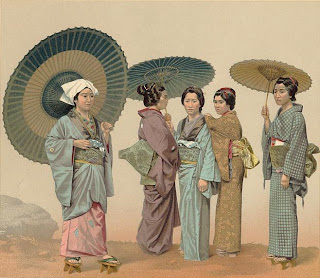
Japanese ancient clothing was majorly influenced by China. Vigorous trade between Japan and its continental neighbors brought in Chinese dresses and styles into Japan during the Han Dynasty. The Tang styles and Sui dynasty from China influenced clothing in Japan while it was developing from a collection of loose clans to an Empire. All robes in Japan were to be worn from left to right just like the Chinese. Right to left was considered barbaric in China and the ‘left over right’ became the conventional rule of wearing a Kimono ever since.

Kimono:The word Kimono actually referred to all types of clothing. It also remains to be the national costume of Japan. Some of the earliest designs of the kimono were hugely influenced by the Hanfu, which is a part of Chinese clothing. During the 8th century, Chinese fashion trends gained popularity amongst the Japanese. The kimono turned into a stylish version during Japan’s Heian period. Over the years, one could see visible changes in the designs of the kimono.

Japanese Traditional Clothing: Footwear and socks.

Tabi:The tabi are actually traditional Japanese socks. These are worn by men as well as women. The tabi is generally ankle high and has a separation between the toe areas. (Between the big toe and the rest of the toes) The jika-tabi are often worn by workmen because they are made of a stronger material.

Zori:The zori formed a major part of Japanese traditional clothing. These were often worn with the kimono. The zori are open sandals that can be described as slip ons. Today, one can see many styles of the zori being used with modern fashion.

After the Heian period, the Kamakura period saw a number of clashes and war clans within Japan. The ancient Japanese clothing soon underwent another change and now clothes became more functional. The number of layers and broad sleeved clothes were shunned for more usable clothing. Soon the imperial land split into a southern and northern court and these people’s lives got influenced by the soft court life. Fights resumed and the gradual decadence is obvious in the elaborate dresses of the period. Women had stopped wearing the Hakama and the robes were lengthened to ankle level. Veils and robes over the head were some strange ways experimented and worn during this time.

Japanese ancient clothing was mainly robes and most of the patterns and designs were religious and auspicious. Dragons were printed with nine yellow dragons and five cloud patterns. These heavily embroidered robes were won by the emperors and were auspicious for the wearer. The Cheongsam was another one piece dress adorned by ancient Chinese women. It had a high neck with a closed collar and short or medium sleeves. Buttoned on sides with a fitted waist, it had slits going up from the sides and complemented their figures.

Sunday, March 4, 2012

Qing Emperors Dress Adhered To A Status Code

In ancient feudal society, it is easy for people to be distinguished from his daily dress, especially for the ordinary people and upper-class. For the sake of working and low statue, ordinary people usually wear dress making of linen in dark color while upper-class prefer the dress making of silk with many valuable decoration.

Among the upper dominated class, the Emperor, without any doubt, designated the color yellow and the dragon emblem on traditional Chinese imperial dress as an exclusive affirmation of their power. You will find the most typical example from the dress of Qing's Emperor and his empress.

Qing emperors' dressQing emperors' dress adhered to a rigid code that specified clothing for every occasion: ceremonial robes for the most formal ceremonial occasions, court wear for holding audiences, auspicious garments worn during the celebration of festive occasions such as Lunar New Year and his birthday, informal clothing to be worn in his private quarters, and travel ensembles to be worn during the hunt, expeditions and inspection tours. Each ensemble consisted of several garments, headgear, belts, shoes and accessories. The ensembles included seasonal variants. Winter garments, for example, were lined with fur.

Requisite silks, gauzes, satins, brocades and damasks of the highest quality were woven in the imperial weaving factory in Suzhou, and the clothing was sumptuously embroidered and embellished with gold, pearls and precious stones.

In Qing dynasties, there happened some cases that empress held the royal court together with emperor. In this case, the empress has to wear a certain kind of court robes to show her status. Winter court hats of empress dowagers and empresses were made of fumed marten and sewn with red wefts. Their hats adorned with pearl, gold pheasant patterns, gems and jade ornaments had protective collar behind the neck with drooping bright yellow ribbons. The winter court robes of empress dowagers, queens and high-ranked imperial concubines were bright yellow, and also decorated with images of dragon patterns. Summer court hats were made of cyan velvet.

Empress dowagers, queens and high-ranked imperial concubines used cyan sheets with gold-wrapped metal trims to decorate their court costumes; images of dragons and Chinese characters Fu (blessing) and Shou (longevity) were embroidered on the clothes. Necklines of dresses of empress dowagers and queens were made of golden filament and decorated with pearls, turquoises and jade ornaments. Three sets of necklaces were hung on the chest when empress dowagers and queens wore court robes. When an empress dowager or queen was in auspicious clothing, she always wore one set of necklace made of pearls, jade and other top-grade materials. Court necklaces of imperial concubines were decorated with ambers, each having 108 beads in four parts divided by three big ones.