Monday, March 26, 2012

Ancient Greek Costumes Are Known For Their Grandeur And Tradition

The legacy of an attire dates back to many centuries. From ancient times, people of the world have used different costumes to adorn themselves; though the style and form of costumes has changed over the years.

Different clothing have been used in various traditions. The attire of kings, especially the battle armor worn by them, contained detailed work on leather. Pale white was a color worn in times of tragedy. In ancient times, the priests brought in the practice of wearing robes.

Ancient Greek costumes are known for their grandeur and tradition. The ancient Greeks loved to drape themselves in different types of clothes. A wide range of costumes were used for different occasions. In theater and drama, a mask constituted an important part of the costumes worn by actors. Ancient Greeks were known the world over for their attire. Costumes worn by them have influenced fashion all over the world. The attire was an integral part of Greek culture. The clothes worn were associated with power and overall status in society. They also formed an important part of celebrations. A victorious king often invited his fellowmen to join in the victory of a battle and everyone wore their best costumes to partake in such celebrations.

Ancient Greek Clothing
In ancient Greek culture, the masks used in theater were made of clay. Linen was also used in making some types of masks. Different variants of costumes in the ancient Greek culture have found their way into books of today's designers who implement such patterns while designing clothes.

The Chiton, a robe worn by the ancient Greeks was a comfortable garment made from wool. The robe had two versions, one up to the thigh and another till the ankle. The sleeves of the robe were designed in such a way, that they allowed the arms to flow freely. This robe was worn by both sexes. The Tunic was two rectangular pieces of cloth interwoven together. Some costumes worn by the ancient Greeks also had buttons made from bone.

The Greek apparel involved a lot of drapery and required great precision and detail. The Himation was another long piece of cloth that the Greeks draped themselves from shoulder to ankle. They loved to wear cloaks which were also called Chalmys. Cloaks were wrapped in different styles around the body. The colors most commonly used by the ancient Greeks were gray and violet. White was a color that was used in some traditions. Pins and brooches were used to hold the clothing together. Petasos, a kind of headgear similar to a hat, was preferred by the men in ancient Greece.

The ancient Greeks gave a lot of importance to their footwear. Sandals were a prominent part of the Greek civilization and different kinds of leather was used in designing them. Kothumus was a popular form of footwear worn by the Greeks. These boots had laces which were tied around the shin. Sandals and boots were helpful on rocky terrains.

In different phases of Greek history, the simplicity and attire of Greek costumes have remained the same. Wedding dresses were also a significant part of ancient Greek culture. The elegant gowns that were used in weddings were known for their simplicity. Even today, gowns worn at weddings are influenced by ancient Greek designs.

Clothes worn in the ancient Greek era paved the way for fashion in the years to come, thus making a significant contribution to the world of fashion.

Saturday, March 17, 2012

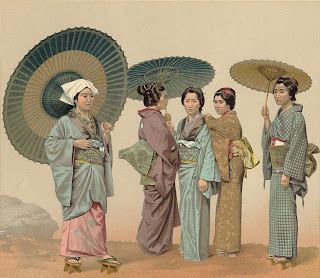
Japanese Ancient Clothing

Japanese ancient clothing was majorly influenced by China. Vigorous trade between Japan and its continental neighbors brought in Chinese dresses and styles into Japan during the Han Dynasty. The Tang styles and Sui dynasty from China influenced clothing in Japan while it was developing from a collection of loose clans to an Empire. All robes in Japan were to be worn from left to right just like the Chinese. Right to left was considered barbaric in China and the ‘left over right’ became the conventional rule of wearing a Kimono ever since.

Kimono:The word Kimono actually referred to all types of clothing. It also remains to be the national costume of Japan. Some of the earliest designs of the kimono were hugely influenced by the Hanfu, which is a part of Chinese clothing. During the 8th century, Chinese fashion trends gained popularity amongst the Japanese. The kimono turned into a stylish version during Japan’s Heian period. Over the years, one could see visible changes in the designs of the kimono.

Japanese Traditional Clothing: Footwear and socks.

Tabi:The tabi are actually traditional Japanese socks. These are worn by men as well as women. The tabi is generally ankle high and has a separation between the toe areas. (Between the big toe and the rest of the toes) The jika-tabi are often worn by workmen because they are made of a stronger material.

Zori:The zori formed a major part of Japanese traditional clothing. These were often worn with the kimono. The zori are open sandals that can be described as slip ons. Today, one can see many styles of the zori being used with modern fashion.

After the Heian period, the Kamakura period saw a number of clashes and war clans within Japan. The ancient Japanese clothing soon underwent another change and now clothes became more functional. The number of layers and broad sleeved clothes were shunned for more usable clothing. Soon the imperial land split into a southern and northern court and these people’s lives got influenced by the soft court life. Fights resumed and the gradual decadence is obvious in the elaborate dresses of the period. Women had stopped wearing the Hakama and the robes were lengthened to ankle level. Veils and robes over the head were some strange ways experimented and worn during this time.

Japanese ancient clothing was mainly robes and most of the patterns and designs were religious and auspicious. Dragons were printed with nine yellow dragons and five cloud patterns. These heavily embroidered robes were won by the emperors and were auspicious for the wearer. The Cheongsam was another one piece dress adorned by ancient Chinese women. It had a high neck with a closed collar and short or medium sleeves. Buttoned on sides with a fitted waist, it had slits going up from the sides and complemented their figures.

Sunday, March 4, 2012

Qing Emperors Dress Adhered To A Status Code

In ancient feudal society, it is easy for people to be distinguished from his daily dress, especially for the ordinary people and upper-class. For the sake of working and low statue, ordinary people usually wear dress making of linen in dark color while upper-class prefer the dress making of silk with many valuable decoration.

Among the upper dominated class, the Emperor, without any doubt, designated the color yellow and the dragon emblem on traditional Chinese imperial dress as an exclusive affirmation of their power. You will find the most typical example from the dress of Qing's Emperor and his empress.

Qing emperors' dressQing emperors' dress adhered to a rigid code that specified clothing for every occasion: ceremonial robes for the most formal ceremonial occasions, court wear for holding audiences, auspicious garments worn during the celebration of festive occasions such as Lunar New Year and his birthday, informal clothing to be worn in his private quarters, and travel ensembles to be worn during the hunt, expeditions and inspection tours. Each ensemble consisted of several garments, headgear, belts, shoes and accessories. The ensembles included seasonal variants. Winter garments, for example, were lined with fur.

Requisite silks, gauzes, satins, brocades and damasks of the highest quality were woven in the imperial weaving factory in Suzhou, and the clothing was sumptuously embroidered and embellished with gold, pearls and precious stones.

In Qing dynasties, there happened some cases that empress held the royal court together with emperor. In this case, the empress has to wear a certain kind of court robes to show her status. Winter court hats of empress dowagers and empresses were made of fumed marten and sewn with red wefts. Their hats adorned with pearl, gold pheasant patterns, gems and jade ornaments had protective collar behind the neck with drooping bright yellow ribbons. The winter court robes of empress dowagers, queens and high-ranked imperial concubines were bright yellow, and also decorated with images of dragon patterns. Summer court hats were made of cyan velvet.

Empress dowagers, queens and high-ranked imperial concubines used cyan sheets with gold-wrapped metal trims to decorate their court costumes; images of dragons and Chinese characters Fu (blessing) and Shou (longevity) were embroidered on the clothes. Necklines of dresses of empress dowagers and queens were made of golden filament and decorated with pearls, turquoises and jade ornaments. Three sets of necklaces were hung on the chest when empress dowagers and queens wore court robes. When an empress dowager or queen was in auspicious clothing, she always wore one set of necklace made of pearls, jade and other top-grade materials. Court necklaces of imperial concubines were decorated with ambers, each having 108 beads in four parts divided by three big ones.

Wednesday, February 29, 2012

Ancient Chinese Clothing-Hanfu

Tang Dynasty portrait of Confucius (by Wu Daozi) showing him in Hanfu of the Spring and Autumn Period of the Eastern Zhou Dynasty.

12th century Chinese painting of The Night Revels of Han Xizai () showing musicians dressed in Hanfu
Hanfu has a history of more than three millennia, and is said to have been worn by the legendary Yellow Emperor. From the beginning of its history, Hanfu (especially in elite circles) was inseparable from silk, supposedly discovered by the Yellow Emperor consort, Leizu. The first solidly historical dynasty known of in China, the Shang Dynasty (c.1600 BC-1000 BC), developed the rudiments of Hanfu; it consisted of a yi, a narrow-cuffed, knee-length tunic tied with a sash, and a narrow, ankle-length skirt, called shang, worn with a bixi, a length of fabric that reached the knees. Vivid primary colors and green were used, due to the degree of technology at the time.

The dynasty to follow the Shang, the Western Zhou Dynasty, established a strict hierarchical society that used clothing as a status meridian, and inevitably, the height of one rank influenced the ornateness of a costume. Such markers included the length of a skirt, the wideness of a sleeve and the degree of ornamentation. In addition to these class-oriented developments, the Hanfu became looser, with the introduction of wide sleeves and jade decorations hung from the sash which served to keep the yoi closed.
The yi was essentially wrapped over, in a style known as jiaoling youren, or wrapping the right side over before the left, because of the initially greater challenge to the right-handed wearer (the Chinese discouraged left-handedness like many other historical cultures, considering it unnatural and unfortunate).

In the Eastern Zhou Dynasty, the "deep robe" (shenyi) appeared a combination of tunic and skirt. The upper and lower halves were cut separately but sewn as a single unit. An additional change was the shaping of the left side of the costume into a corner, fastened on the chest. Perhaps because of Confucian influence, disapproving of a hierarchical society in favour of social mobility based on personal merit, the shenyi was swiftly adopted. There still existed an elite however, and they monopolised the more ornate fabrics and grandiose details.

Historically, Han Clothing has influenced many of its neighbouring cultural costumes, such as Japanese kimono, yukata, and the Vietnamese o t thn. Vice versa, elements of Hanfu have also been influenced by neighbouring cultural costumes, especially by the nomadic peoples to the north, and Central Asian cultures to the west by way of the Silk Road.

Tang Dynasty Hanfu Tang Dynasty was a period of golden age for the people where culture and economy were thriving. Especially, the Women's dress and personal adornments saw some major reform in this era. Although it still continues the clothing of its predecessors such as Han and Sui dynasties, fashion during the Tang was also influenced by its cosmopolitan culture and arts. Communications and trades were flourishing between the Tang and many places and cultures and that it has changed the thoughts and concepts of the old practices. Before the Tang, Chinese women were restricted by the old Confucian code where women's statues were low and their clothing have to be conceal. However during the Tang, women's clothing gradually became broad and loose. Tang Dynasty was considered by some as another turning point for Hanfu. During the Tang era, foreign culture was lively accepted by the Chinese and blended into Chinese traditional culture. Such foreign cultures ranged from Gandhara, Turkistan, Persian to Hellenism, while these influences were fused together into the Tang clothing without the prominence of one particular culture.

Song Dynasty Hanfu Some features of Tang Clothing carried into the Song Dynasty Such as court customs. Song court customs often use red color for their garments with black leather shoe and hats.Collar edges and sleeve edges of all clothes that have been excavated were decorated with laces or embroidered patterns. Such clothes were decorated with patterns of peony, camellia, plum blossom, and lily, etc. Song Empress often had three to five distinctive Jewelry-like marks on their face (Two side of the cheek,other two next to the eyebrows and one on the forehead). Although some of Song clothing have similarities with previous dynasties, some unique characteristics separate it from the rest. Many of Song Clothing goes into Yuan and Ming.

Ming Dynasty Hanfu Ming Dynasty also brought many changes to its clothing as many dynasties do. They implemented metal buttons and the collar changed from the symmetrical type of the Song Dynasty (960-1279) to the main circular type. Compared with the costume of the Tang Dynasty (618-907), the proportion of the upper outer garment to lower skirt in the Ming Dynasty was significantly inverted. Since the upper outer garment was shorter and the lower garment was longer, the jacket gradually became longer to shorten the length of the exposed skirt. Young ladies in the mid Ming Dynasty usually preferred to dress in these waistcoats. The waistcoats in the Qing Dynasty were transformed from those of the Yuan Dynasty. During the Ming Dynasty, Confucian codes and ideals was popularized and it has significant effect on clothing.

Friday, February 24, 2012

Korean Hanbok Shows Perfect Beauty

Traditional Korean dress is called Hanbok in South Korea, and Chosõn-ot in North Korea. Nowadays, Hanbok in general, and mainly refers to from Joseon Dynasty (1392-1897). Changing through from ancient time to today, female hanbok embodys a perfect integration of an Oriental ethics and a plain beauty. Like Chinese Qipao, hanbok has been withdrawn from historic stage, not popular in current life any more, but as semi-formal or formal wear in special ceremonies, which is actually a displayment of a culture heritage. The design is characteristic of simple lines and vibrant colors. The curve of sleeves, white inner edge of the V-shape collar, and the broad long skirt are usually regarded as the three major contributing elements for its attractiveness. Short and small on the top and long and broad in the lower in general design shows a quiet beauty of Korean women.

Historical background

Hanbok changed from Chinese and Mongolian ancient clothing, including men's and women's. Hanbok was originally influenced by ancient Chinese clothing of Tang Dynasty (618-907), during which Korean clothing were almost exactly same with Tang clothing since the current Korean unified Silla Dynasty was closely related to Tang. In 1271, Mongolian people (created Yuan Dynasty in China in 1206) invaded into the current Koryo Dynasty of Korea, and since then Korea had been the tributary state of Yuan for 80 years. During that time, Koryo emperor married the daughter of Yuan emperor, and ordered that all his officials must wear Mongolian costume. From the middle time of Joseon Dynasty, Hanbok began to get developed independently, especially female style, which got changed to high-waistline skirt from the breast-high style of Tang clothing. Since then, Korean Hanbok had been more and more different from Chinese clothing.

The Major Structure
One major feature of Hanbok is the random thinking in design dealing with color, lines and ornaments. Generally, at least two colors are chosen to make more colorful. Women's hanbok shows both curved and straight lines, and the arrangement of thin top and heavy bottom (Jeogori and Chima) makes women look decorous and elegant to underline their virtuousness and tenderness.

Jeogori, the short upper garment, has V-shape collar with inner and outer bands, which is to show the beautiful necks of women, and natural and soft curves of sleeve connects. Chima, the long wide skirt, can hide some flaws of body shape. For example, can make short women look tall, and skinny ones plump.

Cultural taste
Hanbok is mainly made from silk, cotton and linen cloth, and the colors can see social status. Korean people is known for its kindness, generosity and good at singing and dancing. They more admire white color for the cleanness, simpleness and dignity, so has a good fame of "white nation". Therefore, white is the basic color of hanbok. In ancient time, commoners mainly wore white hanbok, and those with bright vibrant colors were allowed to them only in special days, such as wedding days, but upper-class people had diverse colors.

Wedding Hanbok
In traditional weddings, wedding clothing is more glorious compared with regular hanbok. The bride wears yellow Jeogori and red Chima, and special hairpins with front accessories and a ribbon. Modern changed wedding hanboks keep major traditional features, but add modern fashion concept and are simpler.

Wedding Hanbok
In traditional weddings, wedding clothing is more glorious compared with regular hanbok. The bride wears yellow Jeogori and red Chima, and special hairpins with front accessories and a ribbon. Modern changed wedding hanboks keep major traditional features, but add modern fashion concept and are simpler.
Upon its unique changing history and designing concept, female Hanbok is to reveal the unique charm of Korean women known by the decency, the grace and the virtuous. Although it can be rarely seen nowadays in daily life, it still sticks to its important role in traditional and wedding ceremonies to prove the tradition complex of Korean. Therefore, like Chinese Qipao, Korean Hanbok embodies a strong cultural meaning, which carries the sense of national belonging.