The ancient Chinese clothing
had a very distinctive social classes. Every of those has specific types and
significance of dressing. Varied symbols are used on the clothing to distinguish
between numerous strata of society. The ancient Chinese clothes have varied
greatly throughout different periods of time. Each social or historical period
brought about a brand new style.
Throughout the Pre-Qing Dynasty (also recognized because the Manchu Dynasty
was the final ruling dynasty of China from 1644 to 1912.); the prevalent ancient
Chinese clothing was broadly referred to as hanfu with numerous variations such
as traditional Chinese academic dress. Each and every individual stratum
displayed a various fashion. Actually, the military was totally distinctive in
its appearance.
Chinese civil or military officials had an assortment of motifs to depict
their rank and position. Hat knobs were used as an icon of their rank. There had
been nine kinds of color coded hat knobs that represented the nine distinctive
ranks. An additional well-liked insignia was the Mandarin square or rank
badge.
The Chinese clothing known because the Hanfu (also referred to as guzhuang
which means "ancient clothing"), was the conventional dress with the Han Chinese
folk. The term Hanfu has its organ within the Book of Han, which says, "then
numerous came towards the Court to spend homage and had been delighted at the
clothing style of the Han [Chinese]." It had been fascinating for these visitors
to determine the characteristic outfit – like a kimono and sandals created out
of rice reed. As you are able to see, the Hanfu includes a colorful history
dating back 3000 years and more. In fact, the dress was even worn by the
legendary Yellow Emperor. It had been well-liked since long prior to the Qing
Dynasty came into energy within the mid seventeenth century. Since the materials
of this ancient Chinese clothing were always silk, supposedly found by the
Yellow Emperor’s consort, Leizu, the Hanfu was also known as ‘silk robes’.
The Hanfu now is worn only at special occasions, which are mainly historical
reenactment, hobby, coming of age/rite of passage ceremonies, ceremonial clothes
worn by religious priests, or cultural physical exercise. Nevertheless, you will
find attempts on to try and make it a part of more day to day wears or at least
throughout Chinese celebrations and festivals, especially in China also as
amongst the non resident community.
The Ancient Chinese clothes in its most conventional greatest can be
explained as different parts of particular cloth that are draped inside a unique
style. It would be totally different from the conventional garment of other
ethnic groups in China such as the Manchurian qipao. There is a fantastic
difference between the Han way of dressing and the Manchurian influence. It is
as yet an unsolved issue which with the two would be the right traditional
costume with the ancient Chinese. Some costumes commonly thought of as usually
Chinese, like the qipao, are the result of influence by brutal laws (Queue
Order) imposed by Manchurian rulers with the Qing Dynasty, and are regarded by
some advocates as not being "traditionally" Han.
Sunday, July 8, 2012
Friday, June 1, 2012
An Anorak Is A Type Of Heavy Jacket With A Hood

An anorak or parka is a type of heavy jacket with a hood, often lined with fur or fake fur, so as to protect the face from a combination offreezing temperatures and wind. This kind of garment, originally made from caribou or seal was invented by the Caribou Inuit, Inuit (Eskimo) of the Arctic region, who needed clothing that would protect them from wind chill and wetness while hunting and kayaking. Certain types of Inuit anoraks have to be regularly coated with fish oil to keep their water resistance.
The words anorak and parka are now often used interchangeably, but when first introduced, they described somewhat different garments, and the distinction is still maintained by some. Strictly speaking, an anorak is a waterproof jacket with a hood and drawstrings at the waist and cuffs, and a parka is a knee-length cold-weather jacket or coat; typically stuffed with down or very warm synthetic fiber, and with a fur-lined hood. Originally, an anorak specifically implied a pull-over jacket without a zipper, button, or frogged opening, but this distinction is now largely lost, and many garments with a full-length front opening are now described as anoraks. The anorak and parka have been developed from their traditional forms into a number of different designs using modern materials, notably the Fishtail and Snorkel parkas and theCagoule, a form of lightweight anorak.
The Emperor Mong has been hard at work at Princess Productions. Even now I can just imagine the look of surprise on some squaddies face when the gudily pink coloured Princes Productions helicopter got blown out of the sky by a Taliban RPG with wife/gf and baby on board. If it were me I would denomstrate my ‘surprise’ by making ready and switching the change lever on my A2 to automatic and wasting the TV crew and presenter while shouting ‘surprise surprise c*nts!’. However, on a happier note I too would like to see if their managing director would get it but their gash website keeps freezing my PC! – Shaolin Punk
Sorry but having just reads the thread. Which one of you lot will be the reality star for Pick TV or what ever channel they may sell this too. One of the most entertaining threads yet. 1 post and a classic is born.- ark angel
Look, this young innocent lady went out of her way to google British Army, to find the epicentre of all military and human knowledge available on this planet, to research a watery-eyed corporate money-maker off of our and our relatives backs, and to get up in the rankings of one of the ugliest companys known within the shores of Great Britain. – Aleegee 1698
Saturday, May 26, 2012
Scottish Trews Extended Their Life To A Certain Degree
The Scottish Highlands were considered a backwater of Europe, and not worth
much attention, and consequently there are few descriptions or drawings of what
people wore. In addition, few clothing remains have been found. All of this
makes reconstructing a workable outfit rather difficult. Even in the later
periods, documentation, especially for womens' clothing, is sketchy. At the same
time, the Highlands were not absolutely isolated from the clothing trends that
affected the rest of Europe, so one does see changes over time -- for example,
ca. 1100 sleeves throughout Europe were narrow, and that's what we see in the
Rogart Shirt. In the 1500s, wider sleeves were more popular throughout Europe,
and one sees a wider sleeve in Irish clothing, too (albeit in a particularly
Celtic form).
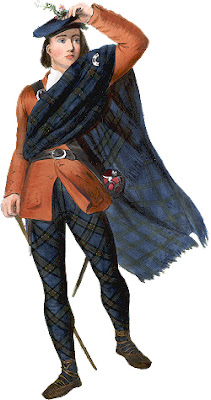
James V wore trews in 1538 so their longevity is not in doubt. They were
always made of tartan and great ingenuity was used in their manufature. They
were cut on the bias - on the cross - so that they had a certain amount of
elasticity and clung to the legs. The sett of the tartan was usually smaller
than seen on the kilt and the hose was carefully crafted to match on the seams
which ran up the back of the leg on the outside - a little like the seams on
old-fashioned ladies' nylon stockings. Having no pockets, the wearer would often
wear a sporran - usually hanging from the belt rather than on the front - and a
plaid would also be worn.
Sixteenth century onwards and had probably been worn for quite some time before that over the saffron tunic - the main article of clothing worn by the Irish.
It was reported that in very bad weather - high winds, frost or snow - the Highlander would dip his plaid in water and then lie down in it. We're told that wetting it like that made the wool swell so that the plaid would give better protection against the wind and cold air. In sub-zero temperatures, it's said that the dipping would result in a thin glaze of ice on the outside surface which would further insulate the occupant. Wrapped up like this with his head under the blanket, the Highlander's breath would then create a warm and moist atmosphere around him which would keep him cosy during the night! As you can imagine, if the poorer Highlanders worked and slept in their plaids they must have been pretty smelly as reported in 1726 in a letter from Captain Burt, an English engineer. " the plaid serves the ordinary people for a cloak by day and bedding at night imbibes so much perspiration that no one day can free it from the filthy smell"
Thearisaidh was the elegant and practical choice for the woman who lived and worked in the beautiful green highlands of Scotland. over a millenia ago. The arisiadhwas worn belted around the waist and the extra fabric could be pinned at the breast and worn up as a hood to keep warm in the rain and cold. The excess could also be rolled and tied about the waist or tucked into the belt in warmer weather and to keep it from interfering with chores. It also provided lots of 'pockets' to perhaps stash a spindle and wool or herbs gathered from the fields.
It was a loose garment made up of around six ells (18 feet/5 metres) of double tartan - Highland looms could only weave a maximum width of 25 to 30 inches (65 - 75 cms) so two lengths had to be sewn together down their long edge to make the plaid (from 'pladjer' - the Gaelic for blanket).
Historians have foisted onto us the idea that the Highlander laid this great expanse of fabric onto the ground and carefully folded it into pleats until its length was reduced to about 5 feet (1.5m). He then lay down on his back on top of it so that the bottom edge almost reached to his knees and gathered it around himself, securing it round his waist by a leather belt. He would then stand up and arrange the unpleated top portion around his shoulders, tucking the corners into his belt to form ingenious pockets.

Sixteenth century onwards and had probably been worn for quite some time before that over the saffron tunic - the main article of clothing worn by the Irish.
It was reported that in very bad weather - high winds, frost or snow - the Highlander would dip his plaid in water and then lie down in it. We're told that wetting it like that made the wool swell so that the plaid would give better protection against the wind and cold air. In sub-zero temperatures, it's said that the dipping would result in a thin glaze of ice on the outside surface which would further insulate the occupant. Wrapped up like this with his head under the blanket, the Highlander's breath would then create a warm and moist atmosphere around him which would keep him cosy during the night! As you can imagine, if the poorer Highlanders worked and slept in their plaids they must have been pretty smelly as reported in 1726 in a letter from Captain Burt, an English engineer. " the plaid serves the ordinary people for a cloak by day and bedding at night imbibes so much perspiration that no one day can free it from the filthy smell"
Thearisaidh was the elegant and practical choice for the woman who lived and worked in the beautiful green highlands of Scotland. over a millenia ago. The arisiadhwas worn belted around the waist and the extra fabric could be pinned at the breast and worn up as a hood to keep warm in the rain and cold. The excess could also be rolled and tied about the waist or tucked into the belt in warmer weather and to keep it from interfering with chores. It also provided lots of 'pockets' to perhaps stash a spindle and wool or herbs gathered from the fields.
It was a loose garment made up of around six ells (18 feet/5 metres) of double tartan - Highland looms could only weave a maximum width of 25 to 30 inches (65 - 75 cms) so two lengths had to be sewn together down their long edge to make the plaid (from 'pladjer' - the Gaelic for blanket).
Historians have foisted onto us the idea that the Highlander laid this great expanse of fabric onto the ground and carefully folded it into pleats until its length was reduced to about 5 feet (1.5m). He then lay down on his back on top of it so that the bottom edge almost reached to his knees and gathered it around himself, securing it round his waist by a leather belt. He would then stand up and arrange the unpleated top portion around his shoulders, tucking the corners into his belt to form ingenious pockets.
Saturday, May 19, 2012
Costume In The Tang Dynasty Plays A Very Essential Role In Chinese History Of Clothing

Thanks to the unified and prosperous Tang Dynasty, costume in the Tang Dynasty plays a very essential role in Chinese history of clothing. The dresses of the Tang Dynasty were mainly made of silk, so they were famous for softness and lightness. The dresses of the Tang Dynasty boldly adopted the features of foreign garments in terms of forms and adornments; i.e. they mainly referred to the garments of other countries (such as the Central-Asia countries, India, Iran, Persia, northern countries and the Western Regions) and used them to improve the habilatory culture of the Tang Dynasty.
One of important features of costume in Tang Dynasty is how women's dress and personal adornments of the Tang Dynasty were outstanding in entire China's history. The clothing materials were exquisite, the structure was natural, graceful and elegant, and adornments were splendid. Though the forms of garments were still the continuation of the Han Dynasty (206BC-220AD) and the Sui Dynasty (581-618), they were influenced by cultures and arts of the Western Regions. The trades and cultural exchanges with Korea, Vietnam, Japan, Persia and other countries gradually became frequent, and they mutually dispatched emissaries and accepted students of other countries. In this way, a special open and romantic style of dress and personal adornments for women was formed.
Because of communication with the Western Regions, the influence of dressing culture of other minorities on the Tang court also reflected the change of thoughts and concepts. Chinese women were seriously restricted by the old Confucian or feudal ethical code before Tang Dynasty. The social status of ancient women was very low. They often served as Jileren (music performer), Guanji (official performer), Gongji (palace performer) and Jiaji (family performer) who were regarded as the playthings and goods that can be sold and bought by rich people for their will. Some females had rebel spirit in the Tang Dynasty, so they climbed or jumped over the walls and went to the nature to view the beautiful sightseeing in the spring by riding horses with men. Just as recorded by many historical materials, some girls therefore dressed as boys in order to go out.
Women's dress and personal adornments of the Tang Dynasty were outstanding in China's history. The clothing materials were exquisite, the structure was natural, graceful and elegant, and adornments were splendid. Though the forms of garments were still the continuation of the Han Dynasty (206BC-220AD) and the Sui Dynasty (581-618), they were influenced by cultures and arts of the Western Regions. Especially, the national power of the High Tang was strong. The trades and cultural exchanges with Korea, Vietnam, Japan, Persia and other countries gradually became frequent, and they mutually dispatched emissaries and accepted students of other countries. In this way, a special open and romantic style of dress and personal adornments was formed.
Women's dress and personal adornments of the Tang Dynasty were outstanding in China's history. The clothing materials were exquisite, the structure was natural, graceful and elegant, and adornments were splendid. Though the forms of garments were still the continuation of the Han Dynasty (206BC-220AD) and the Sui Dynasty (581-618), they were influenced by cultures and arts of the Western Regions. Especially, the national power of the High Tang was strong. The trades and cultural exchanges with Korea, Vietnam, Japan, Persia and other countries gradually became frequent, and they mutually dispatched emissaries and accepted students of other countries. In this way, a special open and romantic style of dress and personal adornments was formed
Because of communication with the Western Regions, the influence of dressing culture of other minorities on the Tang court also reflected the change of thoughts and concepts. Chinese women were seriously restricted by the old Confucian or feudal ethical code all through the ages. The social status of ancient women was very low: they often served asJileren (music performer), Guanji (official performer), Gongji (palace performer) and Jiaji(family performer), and were regarded as the playthings and goods that can be sold and bought by rich people. Some females had rebel spirit in the Tang Dynasty, so they climbed or jumped over the walls and went to the nature to view the beautiful scenes and/or go sightseeing in the spring by riding horses with men. Just as recorded by many historical materials, some girls therefore dressed as boys in order to go out.
It was a fashion for women to wear Hufu (garments of the Tartars or those who lived in the Western Regions). After the High Tang, the influences of Hufu were gradually weakened and women's garments became broad and loose day by day. As to ordinary women's garments, the width of sleeve was always more than 1.3 meters.
Monday, May 14, 2012
Medieval Clothing Was Dictated By The Pyramid Of Power Which Was The Feudal System

"No veils, but such as are made with thread, nor any kinds of fur except those of lambs, rabbits, cats and fox"
A 14th Century Act of Parliament decreed that:
"All labourers and lower classes of people shall wear no kind of cloth but blankets and russets, nor use any girdles than such of those made of linen"
Medieval Clothing - The Fabrics
The type of cloth and fabric used for Medieval clothing was therefore extremely important. People of the Lower Classes wore clothing generally made of wool, linen and sheepskin. Medieval Nobles and Upper classes wore clothing made of velvets, furs, silks, lace, cottons and taffeta. Knights returning from the Crusades returned with silks and cottons from the Middle East. Velvets were imported from Italy. The materials worn by the Nobility came in a variety of different colors. The dyes used for coloring these clothes were expensive. The red dye came from a Mediterranean insect which provided a bright scarlet color. Green dyes came from lychen. the Dyerswoad plant provided dyes for the remaining blue-based colors.
Practical Medieval Clothing
The early Medieval clothing was distinguished by lots of different layers of clothing. Much of the time was spent outdoors or in draughty, cold castles and it was necessary to invest in warm clothing layers.
The Medieval Clothing of Peasants
The Medieval clothing of peasant men consisted of a Knee length tunic fastened with a belt. Others wore linen shirts or rough woollen shirts. Peasant men often went bare-legged or simply bound their legs with strips of linen. Peasant women wore a longer dress made of similar material which was also fastened with a belt.
Medieval Clothing of Noblemen
The Medieval clothing of the Noblemen consisted of trousers covered with long over tunics called bliauds. Tabards and Surcoats were also worn. These clothes were covered with full length cloaks. The cloaks were trimmed with an expensive fur and pinned at the shoulder with a broach. They wore shoes designed for castle wear made of silk, velvet, cloth or leather and fastened with a buckle. The indoor shoes worn with Medieval clothing were covered with wooden and leather outdoor overshoes. Hats were also part of a nobles clothing which were similar to a cap and pointed at the front. The materials were made of velvets, silks, lace, cottons and taffeta and dyed in bright colors. In the 14th century Medieval clothing included underclothes consisting of breeches, chemise and hose. Additional information is available by clicking the following link -Medieval Knights Armor
Medieval Clothing of Noble Women
The Medieval clothing of the Noble women consisted of many layers of clothes. They wore underclothes consisting of breeches, chemise and hose. The underclothes in Medieval Clothing were covered with an underskirt usually made of yellow or white linen or silk. The underskirt was covered with a long, trailing gown, or dress, with wide sleeves. The gowns were made of velvets, furs, silks, lace, cottons and taffeta. The hem and the neck of the gown (dress) and sleeves were often decorated with gems and lace. The gowns were covered with long over tunics called bliauds. Tabards and Surcoats were also worn over the gowns and dresses. These clothes were covered with full length mantel. The mantels were trimmed with an expensive fur and pinned at the shoulder with a broach. They wore shoes designed for castle wear made of silk, velvet, cloth or leather and fastened with a buckle. The indoor shoes were covered with wooden and leather outdoor overshoes. Women wore their hair long and plaited which was covered by a Wimple or a Guimpe - a piece of silk or linen draped and pinned over the hair, wrapped around the throat and tucked into the neckline of the gown. Hats were were later added as part of the clothing of a noble women which grew bigger as fashion dictated featuring tall points, some shaped as the horns of cows. The Medieval Clothing materials were made of velvets, silks, lace, cottons and taffeta and dyed in bright colors.
Peasant men often wore woolen jackets with woolen pants or knickers. This ensemble was sometimes accented with a cottonshirt. Peasant men also wore medium-length tunics with bare legs or stockings. The tunics would be cinched with a rope or sash. Shoes and hats were luxuries that not all could afford, but peasant men sometimes wore shoes and hats made of cloth. What is commonly known as the wench look was the norm for female peasants.
The wench look consisted of a long tunic commonly referred to as a kirtle. Kirtles were made of various materials, but usually of wool or linen for peasants. Kirtles were either laced in front similar to acorset or they were laced down the back. A loose fitting shirt would normally be worn underneath the kirtle if it were short-sleeved. A shirt may or may not have been necessary if the kirtle was long-sleeved. Long-sleeved kirtles usually had bell sleeves, which made an undershirt unnecessary.
Unlike the rich, peasants could not afford the services of tailors, seamstresses, or weavers. Peasants were known to make their own clothes. Money was hard to come by so peasants often resorted to alternate means of meeting their needs. The barter system was popular. Bartering enabled peasants to trade goods or food in exchange for clothes and shoes. If a peasant could make good quality clothes, shoes, or hats, then they were in high demand and had an easy time trading in exchange for necessities.
Subscribe to:
Posts (Atom)